The blue poncho and the red poncho: how to tell the two boats apart
Every photograph of a Niagara boat tells you which country it was taken in, if you know what to look for. A short field guide to the two operations, their ponchos and their boats.
 By Michael Thompson, Niagara Falls boat tour specialist and local guide
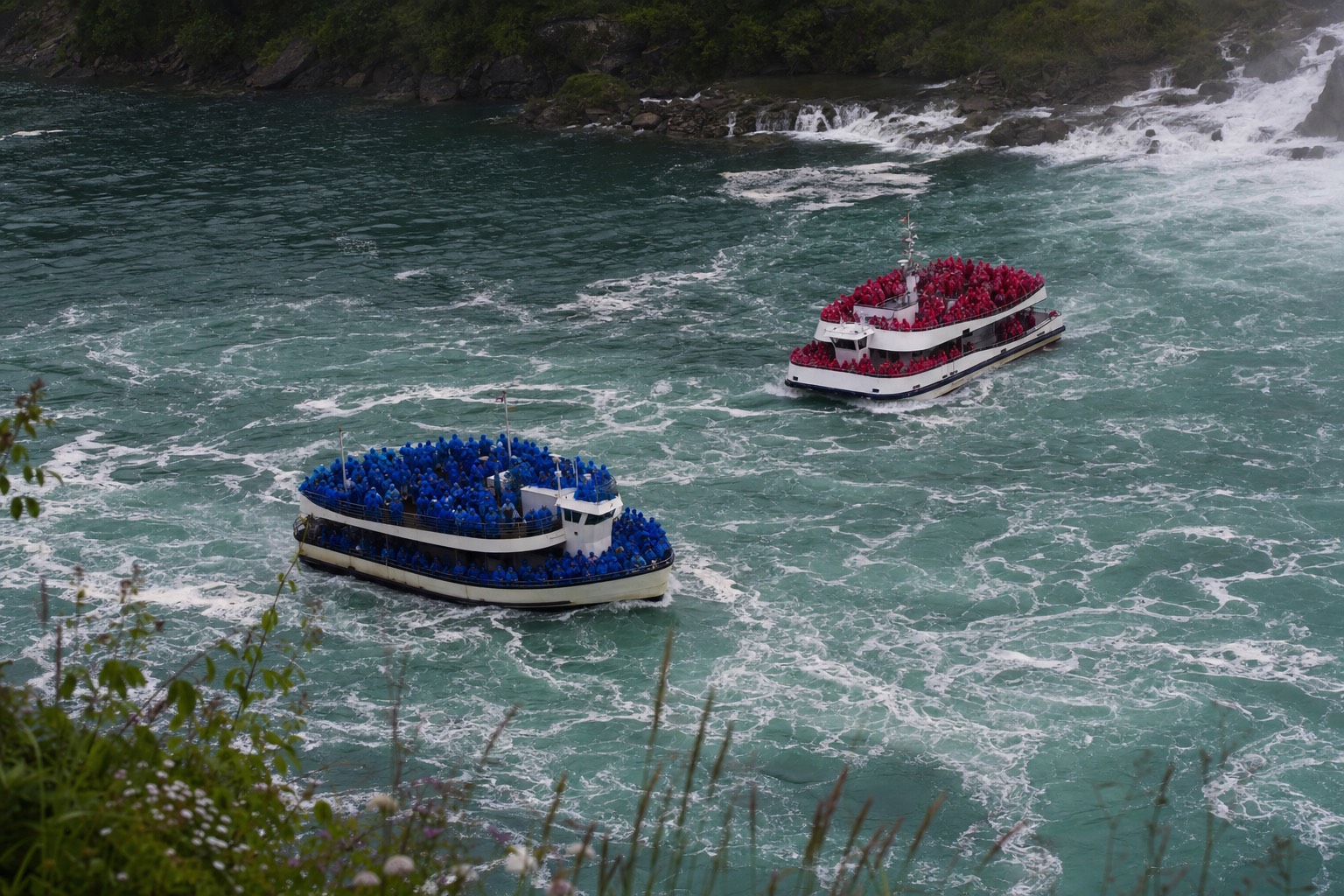
Scroll any Niagara Falls photo feed and you will notice the crowds come in two colours. It looks like a styling choice. It is actually a border.
Blue means you are looking at the United States. Red means Canada. Once you know that, every photograph of the falls tells you which country the photographer was standing in, and a surprising number of travel articles turn out to be using the wrong side's picture.
A guided package is useful when you want the surrounding attractions and logistics as well as a boat ride; it is a different purchase from a boat-only ticket.
Booking choice. Journey Behind the Falls, Skylon Tower and a seasonal Niagara City Cruises ride in one walking itinerary. Explore Canadian walking tour: boat, Journey & Skylon
The two operations, in one table
They are separate companies in separate countries doing an almost identical job, which is why they are so easy to confuse and so easy to distinguish once you have the trick.
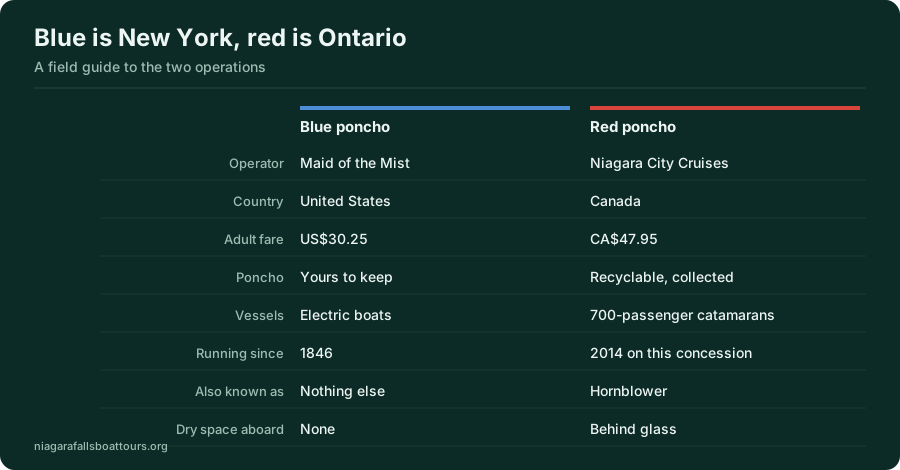
| Blue poncho | Red poncho | |
|---|---|---|
| Operator | Maid of the Mist | Niagara City Cruises |
| Country | United States | Canada |
| Boards at | Prospect Point, Niagara Falls State Park | Lower Niagara Gorge, Niagara Parkway |
| Poncho | Blue, yours to keep | Red, recyclable |
| Vessels | Electric boats | 700-passenger double-deck catamarans |
| Adult fare | US$30.25 | CA$47.95 |
| Running since | 1846 | 2014 on this concession |
| Also known as | Nothing else | Hornblower Niagara Cruises |
| Paired attraction | Cave of the Winds | Journey Behind the Falls |
Why the colours at all?
Practicality first. A poncho on a boat full of several hundred people is a crowd-management tool as much as a courtesy: the crew can see at a glance who has boarded, and passengers can find their group in a fog of spray. Two operators working the same stretch of water arriving at two different colours is the natural result of neither wanting to be mistaken for the other.
The souvenir angle is real too, and only on one side. The American poncho is yours to keep, and a startling number of them leave Niagara in suitcases. The Canadian one is collected and recycled.
What the colour tells you about a photograph
This is the useful part, because it lets you read a picture properly.
| What you see | Where it was taken from |
|---|---|
| Blue ponchos, falls behind | An American boat, so a US-side ticket |
| Red ponchos, falls behind | A Canadian boat |
| The full Horseshoe crestline, head-on | The Canadian bank, from land |
| The falls from above and beside | The American bank, Goat Island or the tower |
| Wooden walkways, people soaked | Cave of the Winds, American side only |
| A rock portal looking out through water | Journey Behind the Falls, Canadian side only |
| Two decks, several hundred people | A Canadian catamaran |
That fifth and sixth row are the giveaway for the attractions people most often mix up. Our Cave of the Winds guide and Journey Behind the Falls guide cover why neither has an equivalent on the other bank.
Does the poncho work?
No, and both colours fail equally. The sides are open, the hood blows back in the circulating air of the basin, and after the first minute the poncho is holding water rather than shedding it. Our getting wet guide has the position-by-position breakdown of how exposed each part of a deck is, which matters far more than what you are wearing over it.
The one genuine difference is that only the Canadian catamarans have enclosed space behind glass. If staying dry matters, that is a reason to pick red over blue, and it is a better reason than any of the ones people usually cite.
The name problem on the Canadian side
The red boat has an identity crisis that the blue one does not. Hornblower Niagara Cruises took the Canadian concession from Niagara Parks in 2014 and the operation was later rebranded Niagara City Cruises. Both names remain in circulation across signage, older articles and search results, which is why people arrive believing they are choosing between two Canadian operators.
There is only one. Niagara Parks still publishes the attraction under a URL carrying the old name, which is a small monument to how sticky a brand can be. Our Canadian ticket guide untangles it.
The American side has had the same name since 1846, which is one of the very few things at Niagara that has stayed still.
What else differs once you are aboard?
The poncho is the visible difference. These are the ones you notice after boarding.
| Aboard | Blue boat (New York) | Red boat (Ontario) |
|---|---|---|
| Deck layout | Single main deck, open | Two decks, plus enclosed space |
| Capacity | Smaller vessels | Up to 700 passengers |
| Crowding at the rail | Tighter per boat, fewer people | More room, more people |
| A dry option | None | Behind glass |
| Boarding system | General queue | Timed entry, sailings roughly every 15 minutes |
| The approach | Longer transit past the American Falls | Shorter run-in, Horseshoe looms sooner |
| What you keep | The poncho | Nothing |
None of those change the four or five minutes inside the basin, which is near identical from either boat. They change everything around it, which is the pattern across this whole comparison.
So which colour should you wear?
Whichever side you are already standing on. That is genuinely the answer, and our comparison page explains why the ride itself is not the deciding factor. If you can reach either, the fare gap favours blue and the view favours red, and the operators' own pages will tell you the rest.
Poncho questions
What colour is the Maid of the Mist poncho?
Blue, and it is yours to keep. That distinguishes it from the Canadian boat, where the red poncho is recyclable and collected at the end of the ride.
What colour is the Niagara City Cruises poncho?
Red, and recyclable. It is handed out before boarding at the lower gorge landing on the Ontario side.
Can you keep the poncho?
On the American boat, yes; the blue poncho is a souvenir. On the Canadian side the red ponchos are collected for recycling rather than kept.
Do the ponchos keep you dry?
Neither does. The sides are open and the hood blows back in the circulating air of the Horseshoe basin. Assume wet hair, shoulders and shoes regardless of colour.
Why do the two boats use different colours?
They are separate companies in separate countries. Distinct colours help crews manage several hundred passengers in heavy spray and stop either operation being mistaken for the other in photographs and marketing.
Choose your Niagara day
General editorial starting point; confirm dates, route and personal requirements.
Canadian walking tour: boat, Journey & Skylon
Have a travel date in mind? Check this itinerary before arranging separate admissions. Journey Behind the Falls, Skylon Tower and a seasonal Niagara City Cruises ride in one walking itinerary.
About 3 hours 15 minutes plus check-in. Choose the Niagara Falls, Canada walking option. Meet inside Skylon Tower, 5200 Robinson Street, at the See Sight check-in. English. Guided portion ends at boat boarding; no return transfer. Winter boat replacement is Niagara Takes Flight, which excludes infants and children under 100 cm. Confirm exact seasonal itinerary and access needs.
Choose a date to see Viator scheduled departures. Final availability and price are confirmed on Viator.
Choose only the details that matter. Unanswered fields keep this general guidance; a choice can rule out a package.
| Canadian walking tour: boat, Journey & Skylon | Journey Behind the Falls, Skylon Tower and a seasonal Niagara City Cruises ride in one walking itinerary. About 3 hours 15 minutes plus check-in. Choose the Niagara Falls, Canada walking option. Meet inside Skylon Tower, 5200 Robinson Street, at the See Sight check-in. English. Guided portion ends at boat boarding; no return transfer. Winter boat replacement is Niagara Takes Flight, which excludes infants and children under 100 cm. Confirm exact seasonal itinerary and access needs. |
|---|---|
| USA boat, Cave & hotel pickup | Maid of the Mist, Cave of the Winds and the Observation Tower in one guided American-side itinerary. About 4 hours, plus pickup up to an hour before. Pickup in Niagara Falls, NY, not Buffalo or NYC. English; shared tour. Boat and Cave operations are seasonal; winter substitutes differ. Food is extra. Confirm access needs with the operator. |
| Both sides with boat, Cave & Skylon | American-side boat and Cave stops plus Skylon Tower views in Canada. About 6 hours, plus pickup and border delays; reserve a full day. Niagara Falls ON/NY hotel pickup. English; shared tour. Appropriate entry documents for both countries required. Reconfirm with Over the Falls at least 24 hours ahead. Vehicles cannot accommodate occupied wheelchairs; assisted transfer and collapsible chairs need advance arrangement. Seasonal substitutions; food extra. |
Compare your own group totals
Use the same currency and the same party. Include admissions, transport, parking and taxes in the DIY total. Quotes are your inputs, not prices supplied here.
Enter both totals to compare the cost of the guided itinerary with your independent plan.