The seven-year-old who went over Horseshoe Falls, and the boat that pulled him out
On 9 July 1960 Roger Woodward went over Horseshoe Falls in a life jacket and survived. A Maid of the Mist crew picked him out of the water. What actually happened, factually.
 By Michael Thompson, Niagara Falls boat tour specialist and local guide
This is the most remarkable thing that has ever happened at Niagara Falls, and it is also a story about three people, two of whom had a very bad day and one of whom did not survive it. Worth telling carefully rather than as a curiosity.
The history adds context to a modern sightseeing visit. Today’s guided boat-and-land itineraries do not recreate historic rescues or rapids runs.
Booking choice. Maid of the Mist, Cave of the Winds and the Observation Tower in one guided American-side itinerary. Explore USA boat, Cave & hotel pickup
What happened on 9 July 1960
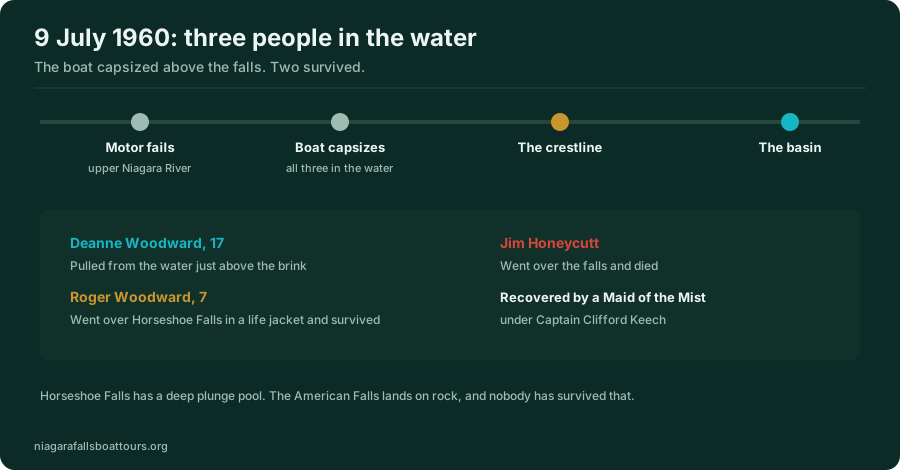
Three people were on the upper Niagara River in a small aluminium fishing boat: seventeen-year-old Deanne Woodward, her seven-year-old brother Roger, and a family friend, Jim Honeycutt.
The boat developed motor trouble above the falls, in the stretch of river where the current accelerates towards the crestline. It capsized. All three went into the water.
What happened next split three ways.
| Person | Age | Outcome |
|---|---|---|
| Deanne Woodward | 17 | Pulled from the water just above the brink |
| Roger Woodward | 7 | Went over Horseshoe Falls in a life jacket and survived |
| Jim Honeycutt | Adult | Went over the falls and died |
Deanne was reached at the very edge and hauled out. Roger was not. He went over Horseshoe Falls wearing nothing but a life jacket, dropped roughly 57 metres into the basin, and came up alive with minor injuries.
His rescue remains one of the best-known events in the history of Maid of the Mist.
The boat pulled him out
The vessel that picked Roger Woodward out of the plunge pool was a Maid of the Mist, under Captain Clifford Keech. That is the detail that connects the story to the boat ride people queue for today: the same operation, working the same basin, doing the same short circuit under Horseshoe Falls.
The boats are not a rescue service and they have never been sold as one. But they are the only crewed vessels routinely working the water directly below the falls, which is why they have been first on scene more than once in the operation's long history.
Our post on whether a boat has ever gone over the falls covers the other side of that relationship: the tour boats work downstream of the drop, which is why nothing that starts on a Maid of the Mist ends up going over.
How does anyone survive that?
The honest answer is that almost nobody does, and the ones who have share a small set of conditions rather than a technique.
| Factor | Why it matters |
|---|---|
| Going over Horseshoe rather than American Falls | The Horseshoe has a deep plunge pool; the American Falls lands on rock |
| Hitting the water clear of the rocks | The single biggest variable, and it is chance |
| Wearing flotation | Keeps an unconscious or winded person face up in the churn |
| Being small and light | Less momentum into the water |
| Being found quickly | The basin is cold and violent, and it recirculates |
| Not being trapped in a container | Barrels and capsules have killed as often as they have protected |
Roger Woodward had four of those going for him. He also had the last one, which is worth noting given how much of Niagara's folklore involves people deliberately climbing into barrels.
The people who did it on purpose
The stunting tradition is older and considerably less admirable. The first was Annie Edson Taylor, a 63-year-old schoolteacher, who went over Horseshoe Falls in a custom oak and iron barrel on 24 October 1901, her birthday, and survived with a cut to the head.
She had hoped it would make her rich. It did not.
Deliberately going over the falls is illegal today on both sides of the border and carries substantial fines. It is also, on the record, far more likely to kill you than to make you famous: the list of people who have gone over Niagara Falls records only around sixteen survivors across the whole documented history, against a much larger number of deaths.
The two falls are not equally survivable
People talk about "going over Niagara Falls" as one event. It is three different waterfalls with three different outcomes, and the distinction decides who lives.
| Horseshoe Falls | American Falls | Bridal Veil Falls | |
|---|---|---|---|
| Where | Mostly Canada | New York | New York |
| Base | Deep plunge pool | Talus, a slope of fallen rock | Rock |
| Drop | About 57 metres | Similar height, different landing | Similar |
| Survivability | The only one with any record of survival | Effectively none | Effectively none |
| What the boats do | Enter its basin | Pass alongside | Pass alongside |
| The 1960 rescue | Happened here | Not here | Not here |
That is the whole of it. Roger Woodward went over the one with water at the bottom rather than rock, which is the difference between the story being remarkable and the story being a third death.
Why the story matters to a visitor today
Two reasons, and neither is morbid.
The first is scale. Standing on the promenade the falls read as scenery. Knowing that a child went over that crestline and lived, and that the man beside him did not, converts the view into something with real physics in it. Around 2,400 cubic metres of water a second is going over that edge, from roughly 57 metres up, into a pool deep enough to have absorbed a seven-year-old.
The second is that the boat you can ride is the boat from the story. The Maid of the Mist has been working that basin since 1846, first as a ferry and then as a sightseeing operation, and the water it circles is where the 1960 rescue happened. That is a rare thing for a tourist attraction: the history is not in a display case, it is under the hull.
A note on how this gets retold
Search results for this story are full of embellishment: invented dialogue, wrong ages, the wrong falls. The version above sticks to what is documented, which is why it is shorter than most retellings and contains no quotations. If you want the falls' broader human history, Niagara Parks' heritage pages are a better starting point than anything algorithmically assembled.
If you are visiting and want to see the water it happened in, our American-side guide covers the boat that made the rescue and how the morning works.
Questions about the 1960 rescue
Who was the seven-year-old who survived Niagara Falls?
Roger Woodward. On 9 July 1960, aged seven, he went over Horseshoe Falls wearing only a life jacket after the boat he was in capsized on the upper river, and survived with minor injuries.
How did Roger Woodward survive?
He went over Horseshoe Falls rather than the American Falls, which has a deep plunge pool rather than rocks at its base; he was wearing a life jacket; he was small and light; and he was recovered quickly. No technique was involved. Almost nobody who goes over survives.
Which boat rescued him?
A Maid of the Mist, under Captain Clifford Keech. The tour boats are the only crewed vessels routinely working the plunge pool directly below the falls, which is why they have been first on scene more than once.
Did anyone die in the 1960 incident?
Yes. Family friend Jim Honeycutt, who was in the boat with Roger and his sister Deanne, went over the falls and died. Deanne, aged seventeen, was pulled from the water just above the brink.
Who was the first person to go over Niagara Falls and survive?
Annie Edson Taylor, a 63-year-old schoolteacher, on 24 October 1901, her birthday. She went over Horseshoe Falls in a custom oak and iron barrel and survived with a cut to the head. She had hoped it would make her wealthy, and it did not.
Is it illegal to go over Niagara Falls?
Yes, on both sides of the border, and it carries substantial fines. The documented record shows only around sixteen survivors across the whole history of people going over, against a far larger number of deaths.
Choose your Niagara day
General editorial starting point; confirm dates, route and personal requirements.
USA boat, Cave & hotel pickup
Have a travel date in mind? Check this itinerary before arranging separate admissions. Maid of the Mist, Cave of the Winds and the Observation Tower in one guided American-side itinerary.
About 4 hours, plus pickup up to an hour before. Pickup in Niagara Falls, NY, not Buffalo or NYC. English; shared tour. Boat and Cave operations are seasonal; winter substitutes differ. Food is extra. Confirm access needs with the operator.
Choose a date to see Viator scheduled departures. Final availability and price are confirmed on Viator.
Choose only the details that matter. Unanswered fields keep this general guidance; a choice can rule out a package.
| USA boat, Cave & hotel pickup | Maid of the Mist, Cave of the Winds and the Observation Tower in one guided American-side itinerary. About 4 hours, plus pickup up to an hour before. Pickup in Niagara Falls, NY, not Buffalo or NYC. English; shared tour. Boat and Cave operations are seasonal; winter substitutes differ. Food is extra. Confirm access needs with the operator. |
|---|---|
| Canadian walking tour: boat, Journey & Skylon | Journey Behind the Falls, Skylon Tower and a seasonal Niagara City Cruises ride in one walking itinerary. About 3 hours 15 minutes plus check-in. Choose the Niagara Falls, Canada walking option. Meet inside Skylon Tower, 5200 Robinson Street, at the See Sight check-in. English. Guided portion ends at boat boarding; no return transfer. Winter boat replacement is Niagara Takes Flight, which excludes infants and children under 100 cm. Confirm exact seasonal itinerary and access needs. |
| Both sides with boat, Cave & Skylon | American-side boat and Cave stops plus Skylon Tower views in Canada. About 6 hours, plus pickup and border delays; reserve a full day. Niagara Falls ON/NY hotel pickup. English; shared tour. Appropriate entry documents for both countries required. Reconfirm with Over the Falls at least 24 hours ahead. Vehicles cannot accommodate occupied wheelchairs; assisted transfer and collapsible chairs need advance arrangement. Seasonal substitutions; food extra. |
Compare your own group totals
Use the same currency and the same party. Include admissions, transport, parking and taxes in the DIY total. Quotes are your inputs, not prices supplied here.
Enter both totals to compare the cost of the guided itinerary with your independent plan.